Finding a show-stopping spring recipe that actually feels special enough for guests but isn’t a total pain to make can be surprisingly tricky. You want something that looks impressive when you bring it to the table, but let’s be real—most of us don’t have hours to spend in the kitchen, especially when you’re juggling everything else life throws at you.
That’s exactly why I love this asparagus galette with ricotta. It hits that sweet spot of looking fancy while being completely doable on a regular weeknight. The buttery, flaky crust comes together easier than you’d think, and the creamy ricotta paired with tender asparagus and leeks makes it feel like something you’d order at a nice restaurant. Plus, that burrata on top? It takes the whole thing to another level without any extra work.
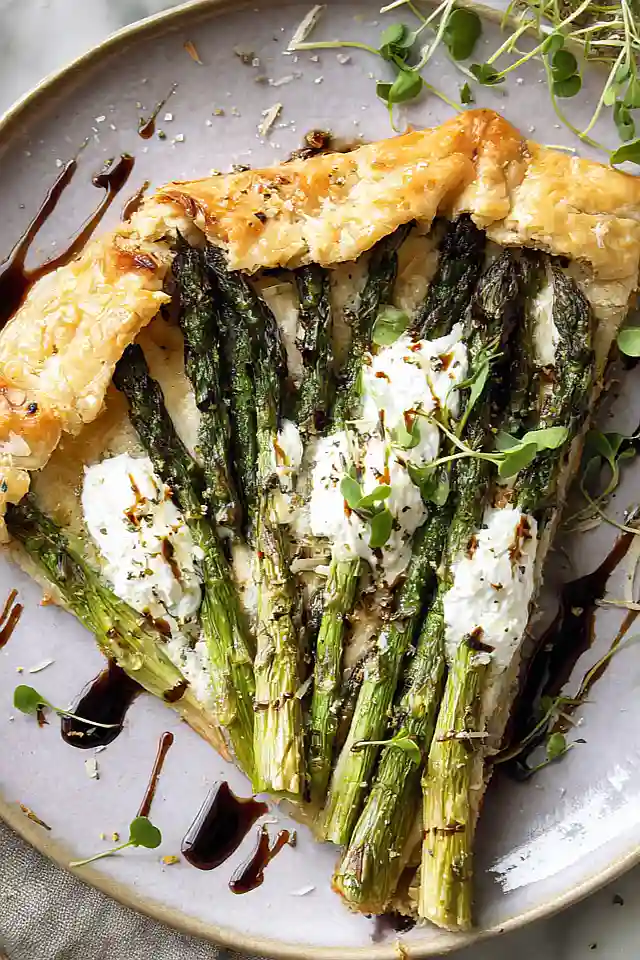
Why You’ll Love This Asparagus Galette
- Impressive yet approachable – This galette looks like something from a fancy bakery, but it’s actually pretty simple to make at home, even if you’re not an expert baker.
- Perfect for spring entertaining – The fresh asparagus and creamy ricotta make this an ideal dish for brunch gatherings, Mother’s Day, or Easter celebrations.
- Rustic, forgiving preparation – Unlike a traditional pie, galettes are meant to look homemade and rustic, so you don’t need to stress about making it perfect.
- Balanced flavors and textures – The buttery, flaky crust pairs beautifully with the creamy ricotta, tender asparagus, and sweet caramelized leeks for a satisfying bite every time.
- Make-ahead friendly – You can prepare the dough in advance and even assemble the galette ahead of time, making it convenient for busy weekends or planned gatherings.
What Kind of Ricotta Should I Use?
For this galette, you’ll want to use whole milk ricotta rather than part-skim, as it has a creamier texture and richer flavor that holds up better during baking. You can find ricotta in most grocery stores in the dairy section, and both store-bought and fresh ricotta from an Italian market will work great here. If your ricotta seems watery when you open it, just drain it in a fine-mesh strainer for about 15 minutes before using – this prevents your galette from getting soggy. Some people prefer the slightly grainy texture of traditional ricotta, while others like the ultra-smooth versions, but honestly either one will give you delicious results in this recipe.

Options for Substitutions
This galette is pretty forgiving when it comes to swaps, so here are some options that work well:
- Whole-wheat flour: If you don’t have whole-wheat flour, just use 2 cups of all-purpose flour instead. The crust will be slightly lighter in color and flavor, but it’ll still be flaky and delicious.
- Leeks: Leeks can be swapped for yellow onions or shallots. Use about 1 cup of chopped onion or 3-4 shallots, and cook them the same way until they’re soft and sweet.
- Ricotta: You can use cottage cheese blended until smooth, or even cream cheese mixed with a bit of milk to loosen it up. The flavor will be slightly different but still creamy and tasty.
- Asparagus: Try using green beans, broccolini, or even thinly sliced zucchini. Just make sure to trim them to similar lengths so they cook evenly.
- Burrata: Fresh mozzarella or even goat cheese work great here. Burrata adds a nice creamy touch, but these alternatives will still give you that melty cheese finish.
- Balsamic glaze: If you don’t have balsamic glaze, you can make your own by simmering regular balsamic vinegar until it reduces and thickens, or just drizzle with good olive oil and skip it altogether.
Watch Out for These Mistakes While Baking
The biggest mistake when making galette dough is overworking it, which develops too much gluten and creates a tough, chewy crust instead of a flaky one – pulse the butter just until you have pea-sized pieces, and handle the dough as little as possible when forming it into a disk.
Another common error is skipping the step where you let the dough sit at room temperature for 20 minutes after chilling, because rolling cold dough straight from the fridge will cause it to crack and tear.
Make sure to thoroughly dry your leeks and asparagus after washing them, since excess moisture can make your galette soggy and prevent the crust from getting crispy on the bottom.
Finally, don’t fold your border too tightly over the filling – leave it loose and rustic so the crust has room to puff up and get golden brown without cracking.

What to Serve With Asparagus Galette?
This asparagus galette is pretty filling on its own, but I love serving it with a simple arugula salad dressed with lemon juice and olive oil to balance out the richness of the ricotta and burrata. A light soup like a spring pea or carrot ginger soup also makes a great starter if you’re serving this for brunch or lunch. Since the galette has such nice spring flavors, it pairs really well with a crisp white wine or sparkling water with fresh herbs. You could also serve it alongside roasted potatoes or a grain salad with farro or quinoa if you want to make it more of a complete meal.
Storage Instructions
Store: This galette is best enjoyed the day it’s made, but you can keep leftovers in the fridge for up to 2 days in an airtight container. The crust will soften a bit as it sits, but it’s still delicious for a quick lunch or snack.
Make Ahead: You can prep the dough up to 2 days in advance and keep it wrapped tightly in plastic wrap in the fridge. The ricotta mixture can also be made a day ahead and stored in a covered container. Just assemble and bake when you’re ready to serve for the best results.
Reheat: Warm leftover slices in a 350°F oven for about 10 minutes to help crisp up the crust again. Skip the microwave if you can, since it’ll make the pastry soggy. Add fresh burrata and a drizzle of balsamic glaze right before serving to brighten it up.
| Preparation Time | 30-40 minutes |
| Cooking Time | 40-50 minutes |
| Total Time | 70-90 minutes |
| Level of Difficulty | Medium |
| Servings | 6 slices |
Estimated Nutrition
Estimated nutrition for the whole recipe (without optional ingredients):
- Calories: 3150-3400
- Protein: 70-85 g
- Fat: 200-215 g
- Carbohydrates: 260-275 g
Ingredients
For the dough:
- 1.25 cups all-purpose flour
- 1 cup whole-wheat flour
- 16 tbsp salted butter (cold and cut into 1/2-inch cubes)
- 4 tbsp ice water
For the filling:
- 2 leeks (white and light green parts only, sliced into 1/4-inch rounds)
- 2 tbsp butter
- 1/2 tsp salt
- 2 tbsp olive oil (I prefer Filippio Berio for sautéing)
- 1.5 cups ricotta (drained to ensure a crisp crust texture)
- Pinch of nutmeg
- 1/2 cup grated parmesan
- 1/2 lb asparagus (tough ends trimmed and cut into 2-inch pieces)
For the finish and garnish:
- 1 egg
- 1 tbsp cream
- 4 oz burrata cheese (torn into bite-sized pieces for topping)
- balsamic glaze (I use Monari Fedezzoni for the perfect acidity)
- flaky salt
- freshly ground black pepper
Step 1: Make the Pastry Dough
- 1.25 cups all-purpose flour
- 1 cup whole-wheat flour
- 16 tbsp salted butter
- 4 tbsp ice water
Pulse the all-purpose flour, whole-wheat flour, and cold butter cubes in a food processor until the mixture resembles coarse breadcrumbs with pea-sized pieces of butter throughout—this creates the flaky texture we want.
Add the ice water a tablespoon at a time, pulsing gently until the dough just begins to hold together when squeezed; be careful not to overwork it or the crust will be tough.
Form the dough into a disk, wrap it in plastic, and refrigerate for at least 1 hour.
I always make my pastry dough ahead of time because it gives the gluten a chance to relax, which makes rolling much easier.
Step 2: Prepare the Leeks and Asparagus
- 2 leeks
- 2 tbsp butter
- 1/2 tsp salt
- 1/2 lb asparagus
While the dough chills, slice the leeks into 1/4-inch rounds, then wash them thoroughly to remove any trapped soil between the layers.
Trim the tough, woody ends from the asparagus and cut the spears into 2-inch pieces.
Heat 2 tablespoons of butter with 1/2 teaspoon of salt in a large skillet over medium heat and cook the leeks for about 10 minutes, stirring occasionally, until they’re completely tender and lightly golden.
This slow cooking sweetens the leeks and drives off excess moisture, which is essential for keeping the galette crust crisp.
Set the cooked leeks aside to cool slightly.
Step 3: Prepare the Ricotta Filling
- 1.5 cups ricotta
- 1/2 cup grated parmesan
- Pinch of nutmeg
In a bowl, combine the drained ricotta, 1/2 cup grated parmesan, and a pinch of nutmeg, stirring gently until just combined.
The nutmeg adds warmth and sophistication to the filling without being obvious—it’s a technique I borrowed from Italian pastry chefs.
Set aside until ready to assemble.
Step 4: Shape and Prepare the Galette
- 2 tbsp olive oil
Preheat your oven to 400°F.
Remove the dough from the refrigerator and let it sit at room temperature for about 20 minutes to make it more pliable for rolling.
Place the dough between two sheets of parchment paper and roll it out into a 14-inch circle, rotating the parchment as you go to ensure even thickness.
Transfer the dough on its parchment to a baking sheet.
Brush the entire surface of the dough lightly with 2 tablespoons of olive oil, leaving a 1.5-inch border uncovered—this helps the crust brown evenly and stay crispy.
Step 5: Assemble the Galette
- ricotta mixture from Step 3
- cooked leeks from Step 2
- 1/2 lb asparagus
- 1 egg
- 1 tbsp cream
Spread the ricotta mixture from Step 3 evenly over the oiled dough, stopping 1.5 inches from the edge.
Layer the cooked leeks from Step 2 over the ricotta, then arrange the raw asparagus pieces on top in a slightly overlapping pattern—the asparagus will cook gently in the oven while the crust bakes.
Fold the dough border up and over the filling, creating loose, rustic pleats as you go around; it should partially cover the filling with a rough, imperfect appearance.
In a small bowl, whisk together 1 egg and 1 tablespoon of cream, then brush this egg wash over the exposed dough border to give it a golden, glossy finish when baked.
Step 6: Bake the Galette
Place the galette in the preheated 400°F oven and bake for 40 minutes, or until the crust is deep golden brown and the asparagus is tender when pierced with a fork.
The pastry should smell nutty and delicious as it bakes.
Remove from the oven and let cool for 5 minutes.
Step 7: Finish and Serve
- 4 oz burrata cheese
- balsamic glaze
- flaky salt
- freshly ground black pepper
While the galette is still warm, scatter the torn burrata cheese over the top, allowing it to soften slightly from the residual heat.
Drizzle generously with balsamic glaze in a crosshatch pattern, then finish with a sprinkle of flaky salt and freshly ground black pepper.
Slice into wedges and serve warm or at room temperature—this galette is wonderful either way.
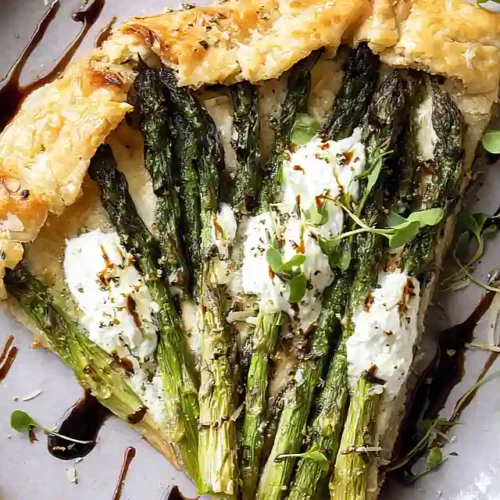
Golden Asparagus Galette with Ricotta
Ingredients
For the dough::
- 1.25 cups all-purpose flour
- 1 cup whole-wheat flour
- 16 tbsp salted butter (cold and cut into 1/2-inch cubes)
- 4 tbsp ice water
For the filling::
- 2 leeks (white and light green parts only, sliced into 1/4-inch rounds)
- 2 tbsp butter
- 1/2 tsp salt
- 2 tbsp olive oil (I prefer Filippio Berio for sautéing)
- 1.5 cups ricotta (drained to ensure a crisp crust texture)
- Pinch of nutmeg
- 1/2 cup grated parmesan
- 1/2 lb asparagus (tough ends trimmed and cut into 2-inch pieces)
For the finish and garnish::
- 1 egg
- 1 tbsp cream
- 4 oz burrata cheese (torn into bite-sized pieces for topping)
- balsamic glaze (I use Monari Fedezzoni for the perfect acidity)
- flaky salt
- freshly ground black pepper
Instructions
- Pulse the all-purpose flour, whole-wheat flour, and cold butter cubes in a food processor until the mixture resembles coarse breadcrumbs with pea-sized pieces of butter throughout—this creates the flaky texture we want. Add the ice water a tablespoon at a time, pulsing gently until the dough just begins to hold together when squeezed; be careful not to overwork it or the crust will be tough. Form the dough into a disk, wrap it in plastic, and refrigerate for at least 1 hour. I always make my pastry dough ahead of time because it gives the gluten a chance to relax, which makes rolling much easier.
- While the dough chills, slice the leeks into 1/4-inch rounds, then wash them thoroughly to remove any trapped soil between the layers. Trim the tough, woody ends from the asparagus and cut the spears into 2-inch pieces. Heat 2 tablespoons of butter with 1/2 teaspoon of salt in a large skillet over medium heat and cook the leeks for about 10 minutes, stirring occasionally, until they're completely tender and lightly golden. This slow cooking sweetens the leeks and drives off excess moisture, which is essential for keeping the galette crust crisp. Set the cooked leeks aside to cool slightly.
- In a bowl, combine the drained ricotta, 1/2 cup grated parmesan, and a pinch of nutmeg, stirring gently until just combined. The nutmeg adds warmth and sophistication to the filling without being obvious—it's a technique I borrowed from Italian pastry chefs. Set aside until ready to assemble.
- Preheat your oven to 400°F. Remove the dough from the refrigerator and let it sit at room temperature for about 20 minutes to make it more pliable for rolling. Place the dough between two sheets of parchment paper and roll it out into a 14-inch circle, rotating the parchment as you go to ensure even thickness. Transfer the dough on its parchment to a baking sheet. Brush the entire surface of the dough lightly with 2 tablespoons of olive oil, leaving a 1.5-inch border uncovered—this helps the crust brown evenly and stay crispy.
- Spread the ricotta mixture from Step 3 evenly over the oiled dough, stopping 1.5 inches from the edge. Layer the cooked leeks from Step 2 over the ricotta, then arrange the raw asparagus pieces on top in a slightly overlapping pattern—the asparagus will cook gently in the oven while the crust bakes. Fold the dough border up and over the filling, creating loose, rustic pleats as you go around; it should partially cover the filling with a rough, imperfect appearance. In a small bowl, whisk together 1 egg and 1 tablespoon of cream, then brush this egg wash over the exposed dough border to give it a golden, glossy finish when baked.
- Place the galette in the preheated 400°F oven and bake for 40 minutes, or until the crust is deep golden brown and the asparagus is tender when pierced with a fork. The pastry should smell nutty and delicious as it bakes. Remove from the oven and let cool for 5 minutes.
- While the galette is still warm, scatter the torn burrata cheese over the top, allowing it to soften slightly from the residual heat. Drizzle generously with balsamic glaze in a crosshatch pattern, then finish with a sprinkle of flaky salt and freshly ground black pepper. Slice into wedges and serve warm or at room temperature—this galette is wonderful either way.